

Medically Reviewed by a Licensed Mental Health Professional | Written by Vibe Edit Team
Why I Started Asking This Question
A few years ago, I was sitting in my college dorm room at 2 a.m., completely overwhelmed. I had been feeling anxious for months, and I finally decided to do something about it. I opened my laptop and typed: therapist vs psychiatrist. Honestly? I got more confused. One site said to see a psychiatrist for medication. Another said a therapist was fine for anxiety. I had no idea what either of them actually did, or which one I needed.
That night planted a seed. Over the years, I have talked to mental health providers, read countless articles, and helped friends navigate their own mental health journeys. So today I am sharing everything I know, laid out in plain language, because this decision matters and it deserves a real answer.
Short Answer: Therapist vs Psychiatrist at a Glance
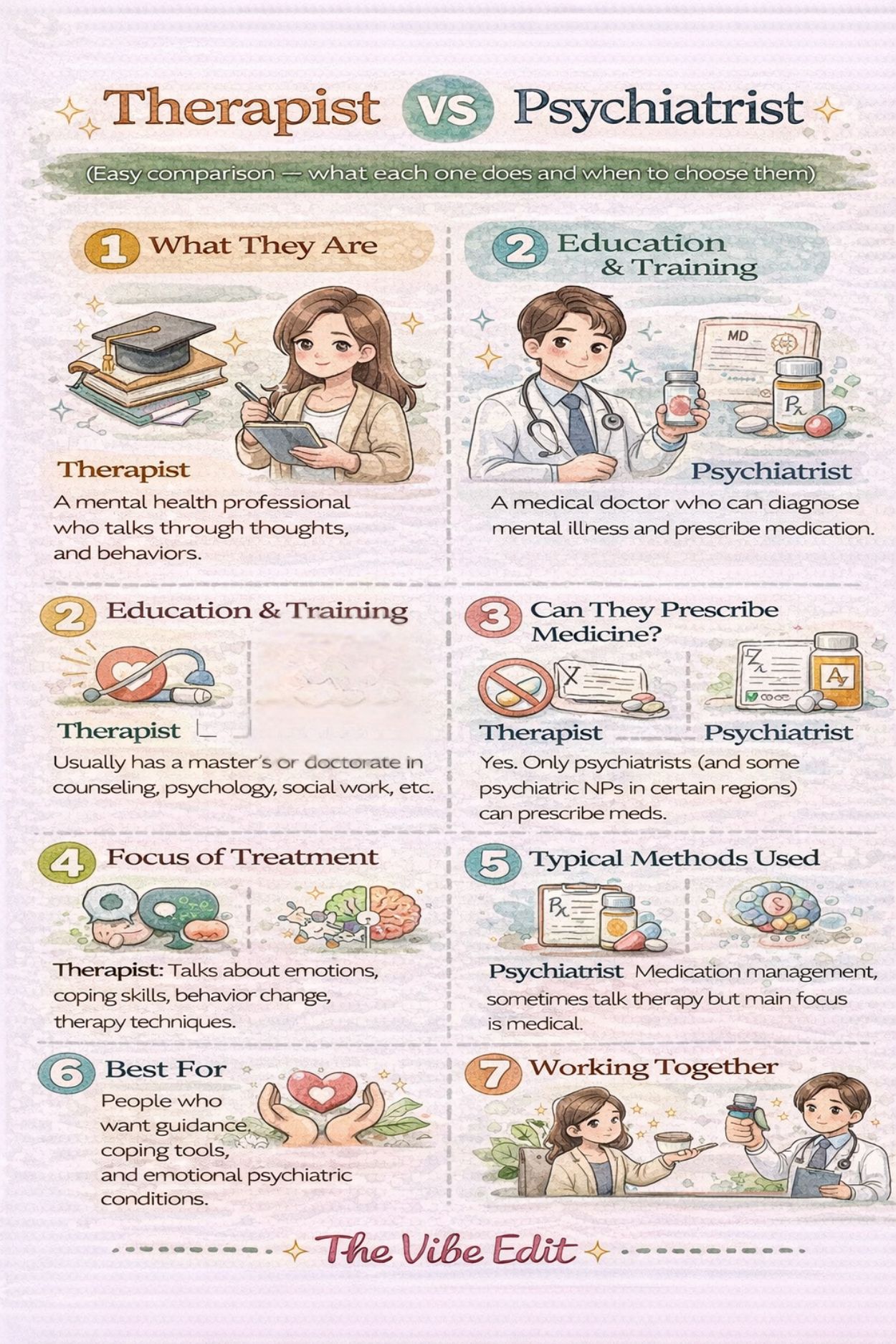
A psychiatrist is a medical doctor (MD or DO) who can diagnose complex mental illnesses and prescribe medication; a therapist provides talk therapy (counseling or psychotherapy) to build coping skills and treat emotional issues, usually holding a master’s or doctoral degree but not prescribing meds.
Quick Comparison Table
| Psychiatrist | Therapist | ||
| Degree | MD or DO | Master’s / Doctoral | |
| Can Prescribe? | Yes | No | |
| Focus | Medication, diagnosis | Talk therapy, counseling | |
| Best For | Complex conditions, meds | Coping skills, patterns |
What Is a Psychiatrist?
Training and Education
A psychiatrist completes four years of medical school, followed by a residency in psychiatry that typically lasts four more years. That is eight-plus years of specialized training before they ever sit across from a patient. Some go on to complete fellowships in specific areas like child psychiatry, addiction medicine, or geriatric mental health.
Because psychiatrists are fully licensed physicians (MD or DO), they have a medical lens on mental health. They can order blood tests, review how physical conditions like thyroid problems or hormone imbalances contribute to mood disorders, and assess whether a medication interaction might be making you feel worse.
What a Psychiatrist Treats
Psychiatrists typically work with conditions that require medical evaluation and medication management, including:
- Major depressive disorder and treatment-resistant depression
- Bipolar disorder and mood disorders requiring stabilizers
- Schizophrenia and other psychotic disorders
- Severe anxiety disorders where medication is part of the treatment plan
- ADHD, OCD, PTSD, and eating disorders with complex presentations
If you have been struggling for a long time, if previous treatments have not worked, or if you suspect your mental health might have a biological or medical cause, a psychiatrist is often the right first call.
Meds, Tests, and What to Expect
During a psychiatric appointment, your provider will take a detailed history, possibly order labs, and work with you to build a treatment plan. If medication is part of that plan, they will prescribe and monitor it over time. Many psychiatrists now offer telepsychiatry, meaning you can meet virtually from home, which has expanded access significantly.
What Is a Therapist?
Types of Therapists and Their Licenses
The word “therapist” covers a range of licensed professionals. Here are the most common you will encounter:
- LCSW (Licensed Clinical Social Worker): Master’s degree, trained in counseling and community mental health
- LPC (Licensed Professional Counselor): Master’s degree, focused on psychotherapy and counseling
- LMFT (Licensed Marriage and Family Therapist): Specializes in relationship dynamics
- Psychologist (PhD or PsyD): Doctoral-level, can diagnose and provide in-depth testing; cannot prescribe in most US states
Each of these roles requires graduate-level training, supervised clinical hours, and state licensure. They are all qualified mental health providers, just with different specialties.
Evidence-Based Therapies They Offer
Therapists use structured, research-backed approaches to help you change thought patterns and build lasting coping skills:
- CBT (Cognitive Behavioral Therapy): The gold standard for anxiety, depression, and OCD
- DBT (Dialectical Behavior Therapy): Particularly effective for emotional dysregulation
- Trauma-focused approaches: EMDR, somatic therapy
- Couples and family counseling: For relationship challenges
Therapy is not just talking about your feelings. It is a structured treatment plan designed to move you toward real, measurable change. Many people find that weekly sessions over a few months create shifts they carry with them for life.
Can a Therapist Diagnose Mental Health Conditions?
Yes, many therapists and psychologists can diagnose and treat mental health conditions, though the depth of medical assessment differs from what a psychiatrist provides. A psychologist especially can conduct detailed psychological testing that a psychiatrist typically does not. However, only a psychiatrist can evaluate and prescribe medication as part of that diagnosis process.
When to See a Psychiatrist vs a Therapist: Your Symptom Checklist
Signs You May Need a Psychiatrist
- Symptoms are severe, sudden, or have not improved with therapy alone
- You are experiencing psychosis, mania, or suicidal ideation
- A doctor suspects a medical cause (thyroid, hormones, sleep disorder)
- You need a formal diagnosis for disability, school, or work accommodations
- You want to explore medication management as part of your treatment
Signs You May Need a Therapist
- You are dealing with life stress, grief, or relationship challenges
- You want to build coping skills through talk therapy
- You have been diagnosed and are stable but want ongoing counseling
- You are ready to dig into patterns, trauma, or communication habits
- Your symptoms are mild to moderate and not requiring medication
Signs You May Need Both
- You are already on medication but feel it is not enough on its own
- Your psychiatrist has limited time and you want deeper psychotherapy
- Your mental health treatment plan calls for combined medication and therapy (this is the most effective approach for many conditions)
Combined Care: When Psychiatry and Therapy Work Together
Why the Best Results Often Come From Both
Research consistently shows that combining medication management with regular therapy leads to better outcomes for conditions like depression, anxiety disorders, and PTSD than either approach alone. This is not a new idea; it has been supported by decades of clinical evidence and endorsed by institutions like the Mayo Clinic and Healthline.
The typical split looks like this: your psychiatrist handles medication check-ins, usually once a month or less frequently once you are stable. Your therapist meets with you weekly or bi-weekly for ongoing psychotherapy. The two providers ideally communicate, share notes, and coordinate your care.
Tips for Coordinating Care Between Providers
- Give each provider permission to communicate with the other in writing
- Bring a list of your current medications to every therapy session
- Tell your therapist if your medication changes and vice versa
- Ask your psychiatrist specifically: “Do you do therapy here, or just medication management?”
Taking care of your mental health is part of a bigger self-care picture. If you are working on building healthier daily habits, check out Work-Life Balance Benefits on Vibe Edit for practical ideas.
Practical Matters: Costs, Insurance, and Telehealth Options
How Much Does Each Cost?
Cost is real and it matters. Generally speaking, a psychiatrist appointment runs higher than a therapy session because of the medical training involved. Initial psychiatric evaluations can range widely depending on location and insurance coverage. Therapy sessions vary by state, license type, and whether you see someone in a private practice or community clinic.
The good news is that teletherapy and telepsychiatry have made both far more accessible and often more affordable. Platforms like Psychology Today’s therapist finder and the SAMHSA helpline can help you locate in-network providers in your area.
Does Insurance Cover Psychiatry and Therapy?
Most major insurance plans cover both mental health services under mental health parity laws. However, coverage varies. Before your first appointment, ask your insurer specifically:
- “Is this provider in-network?”
- “Is the visit billed as therapy or medication management?”
- “How many sessions are covered per year?”
Some psychiatry visits are billed as medical appointments, not therapy, which may affect your copay or deductible. Always verify before you go.
Quick Tip #1: What to Ask When Calling a New Office
“Do you accept my insurance, and do you do medication management, therapy, or both?” This one question saves hours of frustration. You want to know exactly what you are booking before you show up.
Finding a Provider Near You
Start with your primary care doctor for a referral. Use your insurance portal to search for in-network mental health providers. Psychology Today, Open Path Collective, and SAMHSA’s treatment locator are excellent free tools. If wait times are long for in-person psychiatry (which is common), ask about telepsychiatry options, which are often faster.
If stress is showing up physically in ways like morning shakiness or disrupted sleep, you might want to read Why Am I Trembling on Waking? Morning Shakes Explained for insights on how anxiety can affect the body.
3 Real-Life Scenarios: Who Should You See?
Scenario 1: Persistent Anxiety Affecting Daily Life
You have felt anxious for six months. You avoid social situations and your sleep is disrupted. Your anxiety is moderate and you have never tried treatment before. In this case, starting with a therapist is often the right move. A few months of CBT (cognitive behavioral therapy) can make a significant difference. If therapy alone is not moving the needle after a few months, your therapist will often refer you for a psychiatric evaluation.
Scenario 2: Mood Swings That Feel Out of Control
You cycle between periods of very high energy and deep lows. You have had this pattern for years. This presentation warrants a psychiatrist evaluation first. Conditions like bipolar disorder require a medical diagnosis and careful medication management. Therapy alone is not the recommended first-line treatment here.
Scenario 3: Relationship Stress and Grief
You recently lost someone important and are struggling to cope. You are also having communication problems with your partner. A therapist, specifically one who does grief work or couples counseling, is exactly the right fit. There is no medical condition that needs diagnosing here. You need structured support, space to process, and practical skills.
FAQs: Therapist vs Psychiatrist
Q1: Can a psychiatrist provide therapy?
Some psychiatrists do offer psychotherapy, but most focus on medication management and medical evaluation due to time constraints. Always ask when booking: “Do you offer therapy sessions, or is this appointment for medication management only?”
Q2: Can therapists diagnose mental illnesses?
Yes, many licensed therapists and psychologists can diagnose and treat mental health conditions. However, a psychiatrist provides a medical assessment and can prescribe medication as part of the diagnostic process.
Q3: Which is faster to get an appointment with?
In most areas, therapists have more availability than psychiatrists. Psychiatry wait times can be long in many regions. Telepsychiatry has made this better, and many platforms can connect you with a psychiatric provider within days.
Q4: Will insurance cover both?
Most insurance plans cover both therapy and psychiatric visits under mental health parity laws, but verify your plan details. Psychiatric visits are sometimes billed as medical appointments, which may affect your copay. Check whether each provider is in-network before booking.
Q5: What if I think I need both?
This is the most common and often most effective treatment plan. Your psychiatrist handles monthly medication check-ins while your therapist sees you weekly for counseling. With your permission, they can coordinate your care together for the best results.
Quick Tip #2: Download a Symptoms Checklist Before Your First Visit
Write down your symptoms, how long they have lasted, what makes them better or worse, and any medications or supplements you currently take. Bringing this to your first appointment, whether with a therapist or psychiatrist, saves time and helps your provider build an accurate treatment plan from day one.
Physical symptoms and mental health are deeply connected. If you have been noticing unusual body signals, How to Understand Cramps But No Period: 7 Causes You Need to Know explores how stress and hormonal shifts can show up in unexpected ways.
Final Thoughts: You Do Not Have to Figure This Out Alone
If you are still unsure whether to see a therapist vs psychiatrist, start by asking your primary care doctor for guidance and a referral. You can also call a therapist’s office first; a good clinician will tell you honestly if they think you need a higher level of care.
The most important thing is that you reach out. Your mental health is not something to put off until things get worse. Whether you start with talk therapy, medication management, or both, you are making a smart, brave choice by getting support.
You deserve a treatment plan that actually fits your life. Now you know how to find one.














One Response