Quick Answer: Drinking spoiled milk usually causes mild food poisoning symptoms including nausea, vomiting, stomach cramps, and diarrhea within a few hours. A tiny sip often just tastes bad, while larger amounts may need rest and fluids. See a doctor if you have a high fever, bloody stools, or signs of dehydration.
Okay, I have to tell you something embarrassing. Last Tuesday morning, I was half-asleep, running late for work, and I poured myself a big glass of milk without checking the date. One large gulp later, I knew something was very wrong. That thick, sour taste hit me, and I panicked. I stood over the sink wondering: am I about to get seriously sick? Is this going to wreck my entire day?
I grabbed my phone and started searching frantically: what happens if you drink spoiled milk. The results were all over the place. Some sites were dramatic, others too vague. I ended up texting my mom who, being the brilliant home-remedy researcher she is, gave me calm, practical advice that actually helped.
That whole experience made me want to write this post for all of you who might be panicking right now after an accidental sip, or just curious about spoiled milk safety in general. I have put together everything you need to know, from symptoms and timeline to storage tips and when to actually call a doctor.
What Is Spoiled Milk and How Do You Know You Have It?
The Signs That Milk Has Gone Bad
Before we get into what happens inside your body, let us talk about spotting spoiled milk before it reaches your lips. Your senses are your first line of defense.
- Smell: This is the biggest giveaway. Fresh milk has almost no odor. Spoiled milk smells sour, tangy, or like old cheese. Trust your nose every single time.
- Texture: Good milk is smooth and pours cleanly. Spoiled milk may look lumpy, curdled, or slimy. That is a clear sign that bacteria have been busy.
- Taste: If it passed the smell test and you still got a mouthful, sour or bitter flavor means the milk has turned.
- Appearance: Look for yellowish tint, visible chunks, or separation that does not blend back together with a shake.
Why Does Milk Spoil So Fast?
Milk is the perfect environment for bacteria to thrive. It is warm, protein-rich, and full of natural sugars. Even with pasteurization, which destroys most harmful pathogens, milk still contains some harmless bacteria that slowly multiply over time. When temperatures rise above 40°F (4°C), that process speeds up dramatically. Lactic acid bacteria break down the natural sugars in milk and produce lactic acid, which creates that sour smell and taste we associate with spoilage.
The expiration date on your carton is a guideline, not a guarantee. A properly stored container of milk can stay fresh a few days past that date, while a carton left near the warm back of the fridge door may spoil before it.
What Happens If You Drink Spoiled Milk: Symptoms and Timeline
The Most Common Symptoms After Drinking Spoiled Milk
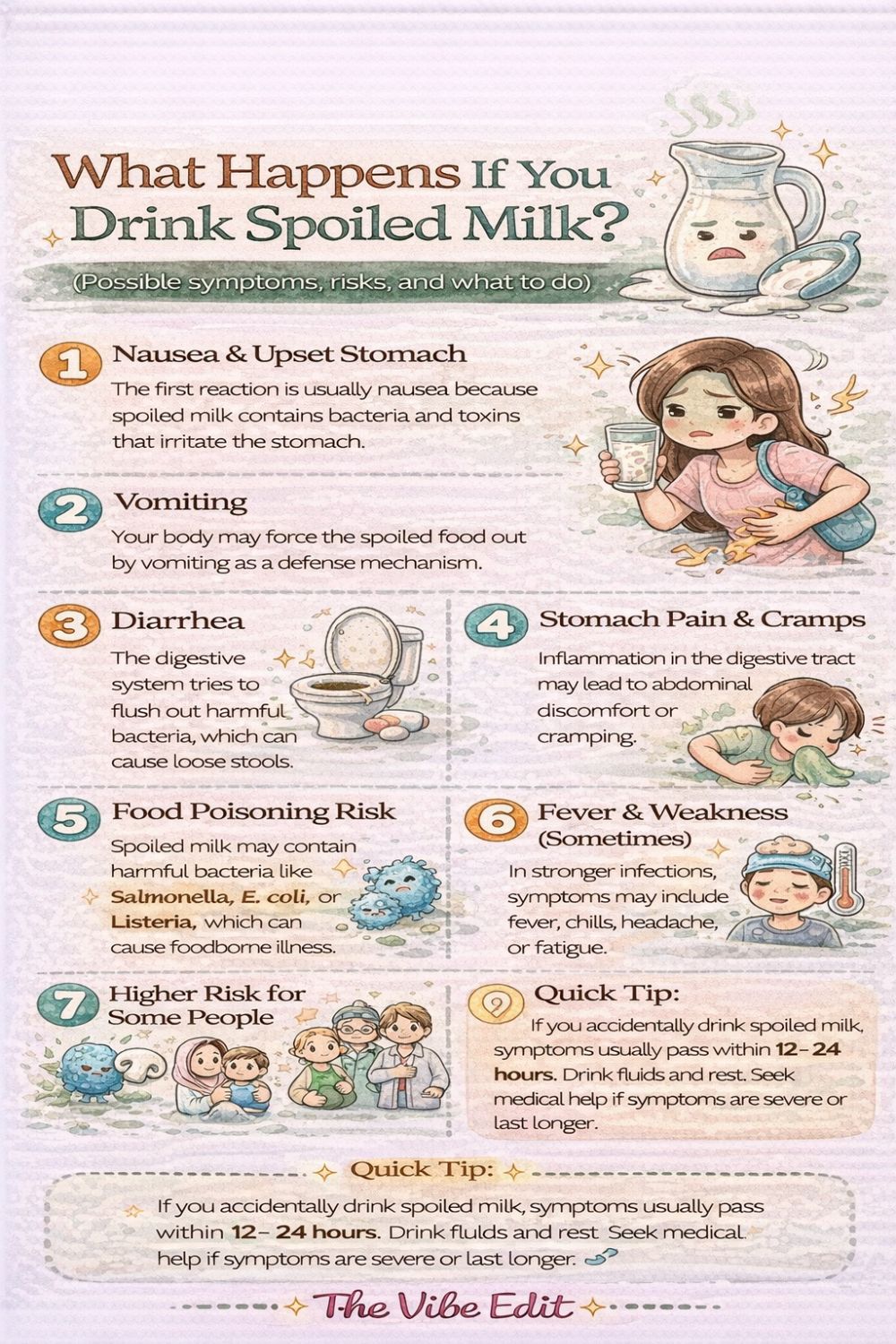
Here is what most people experience after consuming a significant amount of spoiled milk. These are classic signs of food poisoning:
- Nausea: Usually the first thing you feel. Your stomach sends a very clear message that something is wrong.
- Vomiting: Your body’s way of ejecting whatever it does not want. It can be uncomfortable but it is actually protective.
- Stomach cramps: Dull or sharp cramping as your digestive system reacts to the bacteria or acids in the spoiled milk.
- Diarrhea: Loose stools as your intestines try to flush out irritants quickly.
- Bloating and gas: Very common and often one of the first signs, especially if you are sensitive to lactose.
How Soon Do Symptoms Start?
Most people notice symptoms of food poisoning from spoiled milk within one to six hours of drinking it. In some cases it takes up to 24 hours. The speed depends on how much you drank, how heavily contaminated the milk was, and how sensitive your digestive system is.
How Long Do Symptoms Last?
For a healthy adult, symptoms from drinking spoiled milk typically resolve within 12 to 24 hours with rest and fluids. If your symptoms persist beyond 48 hours or intensify, that is your sign to seek medical attention.
Symptoms Timeline at a Glance: 1 to 6 hours: Nausea, stomach cramps, bloating 6 to 12 hours: Possible vomiting and diarrhea 12 to 24 hours: Gradual improvement with rest and fluids 48+ hours with no improvement: See a doctor
What Happens If You Just Sipped a Little?
If you took one small sip and immediately spit it out, you are most likely fine. The small amount is unlikely to cause serious harm in a healthy adult. You may notice a lingering bad taste, some mild nausea, or an upset stomach, but serious food poisoning symptoms from a tiny amount are rare.
My own experience? I had about half a glass, and I ended up with cramping and nausea for most of the morning. By afternoon I was feeling better after drinking lots of water and skipping my usual heavy lunch.
Who Needs to Be Extra Careful With Spoiled Milk?
High-Risk Groups
While most healthy adults recover quickly, certain groups face a higher risk of serious illness from food poisoning caused by contaminated or spoiled milk:
- Young children: Their immune systems are still developing and they are more vulnerable to dehydration.
- Elderly adults: A weaker immune response means pathogens like Salmonella, Listeria, and coli can cause more serious illness.
- Pregnant women: Especially at risk from Listeria, which can cause pregnancy complications. The CDC specifically warns against raw milk during pregnancy.
- People with weakened immunity: Anyone on immunosuppressant medications or undergoing treatment that lowers immune response.
- People with lactose intolerance: The increased bacterial activity in spoiled milk can make lactose intolerance symptoms much worse.
Raw Milk vs Pasteurized Milk: A Critical Difference
This is where it really matters. Pasteurization kills the most dangerous pathogens like Campylobacter, E. coli, Listeria, and Salmonella. If your milk has been through the pasteurization process (which almost all commercial milk has), spoiled milk is much less likely to carry these dangerous bugs, and the illness you get is more likely to be from sour taste and bacterial acids rather than a true pathogen.
However, raw milk that has not been pasteurized is a completely different story. The CDC and FDA both warn strongly against drinking raw milk precisely because it can carry all of the above pathogens, and those risks multiply when the milk also begins to spoil. Raw milk risks are especially serious for children, pregnant women, and older adults.
When to Seek Medical Care: Red Flags You Should Not Ignore
Go to a Doctor If You Notice Any of These
Most cases of upset stomach from spoiled milk resolve at home. But call your doctor or go to urgent care if you experience:
- High fever (above 102°F / 38.9°C): This suggests your immune system is fighting something more serious.
- Bloody stools or bloody vomit: A sign that the infection is more severe than typical food poisoning.
- Symptoms lasting more than 48 hours: Persistent vomiting, diarrhea, or nausea needs professional evaluation.
- Signs of dehydration: Dark urine, dry mouth, dizziness, or not urinating for many hours.
- Severe stomach cramps: Cramping that does not ease with rest or gets progressively worse.
Parent’s Reminder: If a young child drinks spoiled milk and develops any of the above symptoms, do not wait. Children dehydrate faster than adults. Contact your pediatrician or an urgent care provider right away.
How to Store Milk Properly and Prevent Spoilage
Fridge Storage Best Practices
Good storage habits are the best way to avoid this situation entirely. Here is what actually works:
- Keep milk at 40°F (4°C) or below: This is the FDA-recommended safe refrigerator temperature. Use a fridge thermometer to check. Guessing is not enough.
- Store milk away from the door: The fridge door is the warmest spot and experiences the most temperature fluctuations every time you open it. Keep milk on an inner shelf.
- Check the expiration date when buying: Choose containers with the latest possible expiration date at the store.
- Do not return milk to the original container: If you pour milk into a glass or pitcher, do not pour it back. Contamination speeds up spoilage.
- Use the two-hour rule: If milk has been left out at room temperature for more than two hours, discard it. The FDA recommends this for all dairy.
Smart Grocery and Transport Tips
The cold chain matters from store to fridge. Here is how to protect your milk during that window:
- Pick up milk last at the grocery store so it spends the least time at room temperature.
- Use an insulated shopping bag on warm days, especially if the drive home takes more than 20 minutes.
- Buy smaller containers if you live alone or do not use milk quickly. You will waste far less and lower your chances of a spoiled glass.
- Consider freezing milk if you know you will not use it in time. Milk freezes well and thaws in the fridge overnight.
Can You Still Use Slightly Sour Milk for Cooking?
When It Is Okay and When to Toss It
This is a question I asked my mom the morning of my own spoiled milk incident. The answer is nuanced. Mildly sour milk, the kind that smells slightly off but has no chunks, no mold, and no sliminess, can sometimes still be used safely in baking. The heat from cooking destroys most of the bacteria, and the acidity of the sour milk can actually work in your favor for things like:
- Pancake batter (the acidity reacts with baking soda for extra fluffiness)
- Homemade breads and muffins
- Savory dishes like soups or curries where milk is fully cooked through
However, if the milk is visibly curdled, has mold, smells truly foul, or you are cooking for high-risk people (children, elderly, pregnant family members), skip the cooking workaround and just discard it. No recipe is worth the risk of a serious bout of food poisoning.
Frequently Asked Questions About Drinking Spoiled Milk
Will a sip of spoiled milk definitely make me sick?
Not necessarily. Most healthy adults who take a small sip of spoiled milk only experience an unpleasant taste. The symptoms of food poisoning are much more likely with a larger amount. Your stomach acid helps neutralize small quantities of bacteria before they cause real trouble.
How long after drinking spoiled milk do symptoms start?
Typically within one to six hours, though in some cases symptoms like diarrhea and vomiting can take up to 24 hours to appear. The timing depends on how contaminated the milk was and how much you consumed.
Which bacteria should I be worried about in spoiled milk?
The most common pathogens found in contaminated milk include Listeria, Salmonella, E. coli, and Campylobacter. These are especially dangerous in raw milk that has not gone through pasteurization. Commercial pasteurized milk that has simply soured is more likely to cause discomfort from bacterial acids than from dangerous pathogens.
When should I see a doctor after drinking spoiled milk?
Seek medical care if you develop a high fever (above 102°F), bloody stools, symptoms lasting more than 48 hours, or any signs of dehydration such as dizziness, dark urine, or extreme dry mouth.
Can I cook with slightly sour milk to make it safe?
Mildly sour milk without visible mold or chunks can sometimes be used in baked goods where high heat is applied throughout. However, if you have any doubts, or if you are cooking for children, elderly, or pregnant people, it is best to discard it. Your health is worth more than saving a cup of milk.
2 Quick Tips to Never Deal With This Again
Tip 1: Store Milk at the Back of the Fridge, Never the Door
The door rack feels convenient, but it is the warmest spot in your fridge. Every time the door opens, the temperature fluctuates. Keep your milk on the middle or lower shelf toward the back where the temperature stays consistently at or below 40°F. This simple habit can add two to three extra days to your milk’s freshness.
Tip 2: Buy Smaller Containers and Use Them Fast
If you live alone or your household does not go through milk quickly, buy half-liter or one-liter containers instead of large ones. Yes, the per-liter cost is slightly higher, but you will waste far less milk and reduce the chances of ever drinking a spoiled glass by accident. When traveling, always use an insulated bag and buy sizes you can finish in the same day.
The Bottom Line: What Happens If You Drink Spoiled Milk
Look, if you are reading this in a panic right now, take a breath. Accidentally drinking a small amount of spoiled milk is unlikely to send you to the hospital. You will probably feel some nausea, maybe some stomach cramps, and it will pass.
But if you had a full glass, or if you are in a high-risk group, take it seriously. Watch for red flag symptoms like high fever, bloody stools, and signs of dehydration. Do not hesitate to call a doctor if things do not improve within 24 to 48 hours.
The real takeaway? Check your milk before you drink it. Smell it. Look at it. Know where it lives in your fridge. A few seconds of this habit can save you a miserable morning. I learned that the hard way.