

A few months ago, I sat in my car outside my parents’ house, rehearsing a sentence I couldn’t say out loud. My boyfriend had asked me to move in, my mom had asked (again) when we’d get engaged, and three friends had posted ring photos in the same week. Everything felt urgent, and I had no idea what I wanted.
If that sounds familiar, you’re in the right place. I’m sharing what helped me learn how to handle relationship pressure without losing myself. This is the kind of honest talk we love at Vibe Edits, and I hope it saves you a few sleepless nights.
Quick answer: To handle relationship pressure, identify what is making you feel rushed, clarify what you actually want, and communicate your boundaries calmly. Give yourself time to make decisions, seek support from someone you trust, and remember that a healthy partner respects your pace and consent.
How to Handle Relationship Pressure: Understanding What You Are Feeling
What Is Relationship Pressure, and Why Does It Happen?
Relationship pressure is the feeling that you must move faster, commit harder, or agree to something before you are ready. It can come from a partner, parents, friends, or your own head.
It happens because humans are social. We compare ourselves, we worry about timing, and we hate disappointing people we love. Add some relationship anxiety, and a casual question like “So what’s next for you two?” can feel like a deadline.
Here’s a number that surprised me. Pew Research Center reported in February 2024 that among never-married Americans aged 18 to 34, 73% felt little or no pressure from their parents to marry. Another 15% felt some, and 12% felt a great deal or a fair amount. So family pressure is real, but it isn’t universal, and your experience counts either way.
Signs You’re Feeling Pressured in a Relationship
Pressure rarely announces itself. It tends to show up in small, sneaky ways. Here are the signs I learned to watch for:
- A tight chest or racing thoughts when a certain topic comes up
- Saying yes quickly, then feeling resentful later
- Guilt whenever you ask for personal space
- Checking what other couples are doing and measuring yourself against them
- Dreading a call or text because you know a question is coming
For me, it was the car. I’d sit there for ten extra minutes before going inside, just to avoid one conversation. That was my body telling me something my mouth hadn’t said yet.
Where Is the Pressure Coming From?
Before you can fix anything, you need to know the source. Most pressure falls into four buckets.
Pressure From a Partner
This is the hardest one to talk about because you love the person. A partner may want to move faster on commitment, texting habits, or physical intimacy. Sometimes it’s honest excitement, and sometimes it’s something heavier.
Pressure From Family
Parents and relatives often mean well, but “When are you getting married?” can land like a countdown clock. Their expectations usually come from their own fears and traditions.
Pressure From Friends and Social Media Comparison
Scrolling through engagement posts and “relationship goals” photos is a fast way to feel behind. Social media comparison shows everyone’s highlight reel and none of their doubts.
Pressure You Put on Yourself
This one surprised me most. Half of my stress came from a timeline I had invented in my head. Ask yourself honestly whether the voice rushing you is your own.
What Does a Healthy Relationship Pace Look Like?
In a healthy relationship, both people feel safe saying “not yet” without fear of punishment. Decisions are shared, disagreements are allowed, and nobody keeps score of who gave in last.
Moving at your own pace doesn’t mean you don’t care. It means you want to say yes for real reasons, not out of guilt. If a decision only works when one person ignores their own comfort, it isn’t ready.
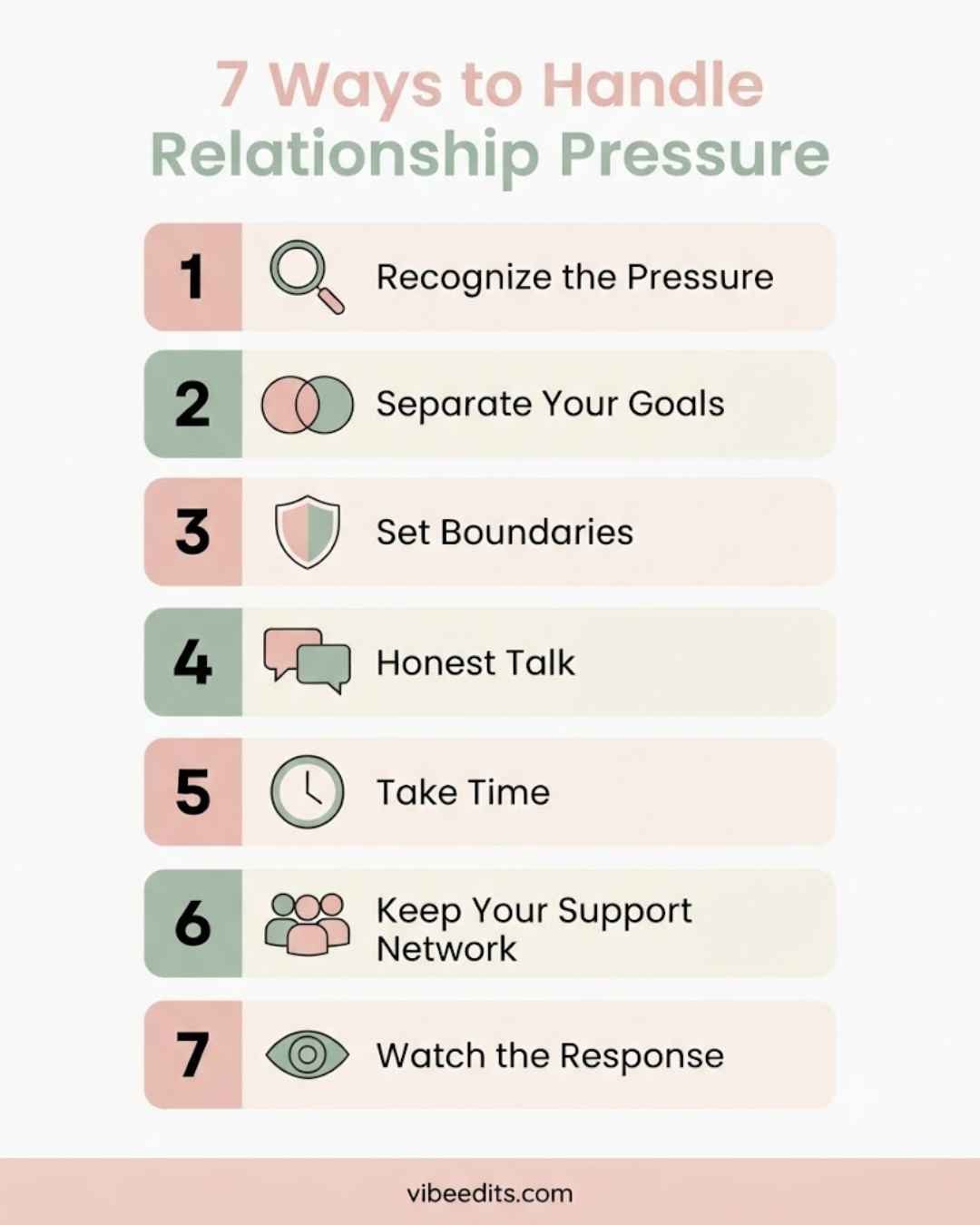
How to Handle Relationship Pressure in Real Life: 7 Steps That Worked for Me
Here is the practical part. These steps are simple, but they’re not always easy. Take them one at a time.
1. Recognize What Is Making You Feel Pressured
Start by naming it. Write down the exact moment your stomach tightens. Is it a question, a person, or a date on the calendar?
Once I wrote “moving in by January” on a sticky note, it stopped feeling like a vague fog and started feeling like a decision I could actually think about.
2. Separate Your Goals From Other People’s Expectations
Make two lists. One is what you want, and the other is what everyone else seems to want for you. Seeing them side by side is oddly freeing.
Some items will overlap, and that’s fine. The point is to know which goals are yours before you act on them.
3. Decide Which Boundaries Matter Most
Learning how to set boundaries in a relationship begins with knowing your limits. Think about emotional boundaries (how much you share and when), personal boundaries (your time, privacy, and body), and practical ones like money and living arrangements.
You don’t need fifteen rules. Pick the two or three that matter most right now, and start there.
4. Have an Honest, Specific Conversation
Good communication with your partner is calm, clear, and kind. Choose a quiet moment, not the middle of an argument. Use “I” statements, such as “I feel rushed when we talk about moving in, and I need more time.”
Describe the behavior, share the feeling, and ask for one realistic change. Then listen to the answer.
5. Give Yourself Time Before Major Decisions
You are allowed to say, “I’ll get back to you.” A pause protects you from promises made out of guilt.
I started giving myself a few quiet minutes each morning to think before any big talk. If you want a simple routine, Dr. Gina Sam’s 7-second morning ritual is an easy way to start the day grounded instead of rushed.
6. Protect Your Independence and Support Network
Pressure grows when your world shrinks to one person. Keep your friendships, hobbies, and routines alive. Treat them as part of a healthy relationship, not as competition for it.
My weekly reset helped more than I expected. I’d plan a self-care Sunday routine, try a DIY hair mask, and spend time with people who knew me before the relationship. A small thing like tidying my desk cables also made my space feel calmer. Calm spaces make clear thinking easier.
7. Watch How the Other Person Responds to Your Boundaries
This step tells you the most. A caring partner may be disappointed, but they’ll respect your answer. A pressuring one argues, sulks, or keeps asking until you give in.
Pay attention to what happens after you say no, because that reaction shows you what the relationship is really like.
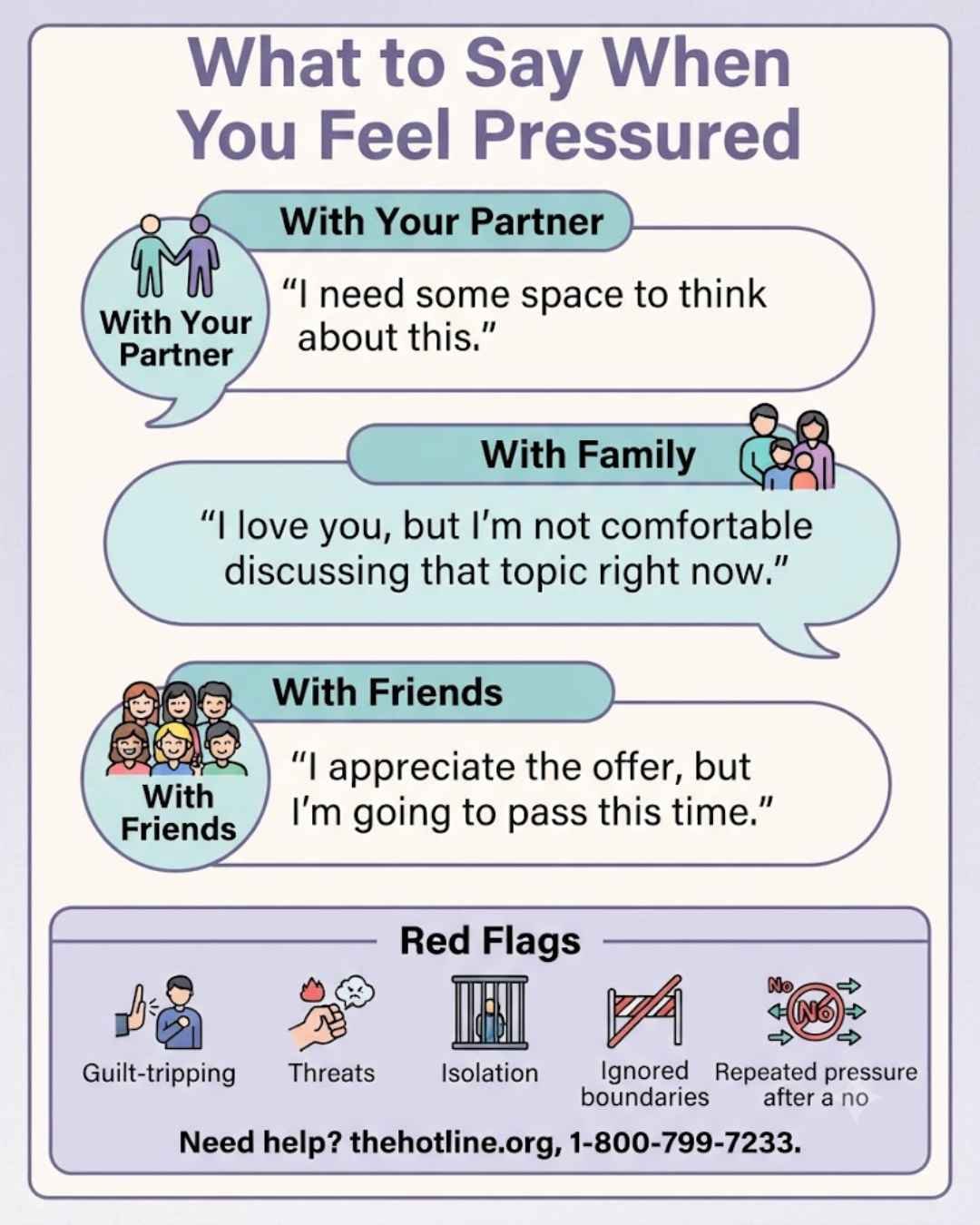
What to Say When You Feel Pressured
Scripts helped me more than any theory, because I froze in the moment. Here are lines you can borrow and adjust.
With a partner:
- “I care about this relationship, but I’m not ready to make that decision yet. I need us to respect each other’s pace.”
- “I hear that this matters to you. I need a few days to think, and I’ll give you a real answer.”
With family:
- “We’re making this decision together and aren’t discussing a date yet.”
- “I know you care. I’ll share news when there is news.”
With friends:
- “I’m happy for you, but comparing timelines isn’t helping me. Can we talk about something else?”
Repeat your line calmly as many times as you need. You don’t owe a long explanation.
How to Handle Different Types of Relationship Pressure
How to Handle Pressure to Get Married
If you’re wondering how to handle pressure to get married, remember that there’s no universal timeline. Marriage should reflect both partners’ readiness, not a relative’s schedule. Thank your family for caring, then restate your answer without apology.
Moving In Together
Talk about money, space, and expectations first. A move that happens because someone is hurt or impatient often creates more tension later. Agree on a check-in date instead of a rushed yes.
Texting and Constant Contact
Needing time offline is normal. Say something like, “I’ll reply when I can, and it isn’t about you.” Mutual trust beats constant availability.
Physical Intimacy and Consent
Consent is never owed because of dating, marriage, or past yes answers. You can say no or “not now” at any time, and a partner should respect it without guilt or sulking. If someone keeps pushing after you’ve said no, that’s a serious concern.
When Does Relationship Pressure Become a Red Flag?
Knowing the signs of an unhealthy relationship matters. A difficult conversation is normal. Repeated controlling behavior is something else.
Watch for these patterns:
- Guilt-tripping whenever you say no
- Threats, including threats to leave or to hurt themselves
- Pushing you to cut off friends or family
- Ignoring your boundaries after you state them clearly
- Pressure for physical intimacy or commitment that continues after a no
If this is happening, it isn’t your failure to communicate better. You deserve to feel safe.
What to Do When Your Partner Pressures You
If you’re asking what to do when your partner pressures you, start with your safety and your support system. State your boundary once, clearly. Notice whether behavior changes. Then talk with someone you trust about what you’re seeing.
You don’t have to decide everything alone, and you don’t have to prove it’s “bad enough” before you ask for help.
When to Seek Outside Support
Reach out to a trusted friend, relative, or licensed counselor if the pressure affects your sleep, mood, or daily life. Counseling can also help if you simply want practice finding the words.
If you’re facing threats or coercion in the US, the National Domestic Violence Hotline offers free, confidential support at 1-800-799-7233, or you can text START to 88788. Their website, thehotline.org, also explains healthy consent and warning signs.
A gentle movement break can help in between hard conversations. This beginner-friendly morning yoga routine is a calm way to reset when your mind is racing.
Frequently Asked Questions About Relationship Pressure
1. What does relationship pressure feel like?
It can feel like anxiety, urgency, guilt, or fear that saying no will cause conflict or rejection.
2. How do I tell my partner I feel pressured?
Choose a calm moment, describe the specific behavior, explain what you need, and ask for a realistic change.
3. Is it normal to feel pressure to get married?
Some people do, but there is no universal timeline. Marriage decisions should reflect both partners’ readiness, not just outside expectations.
4. What if my partner keeps pushing my boundaries?
Repeatedly ignoring your no, using guilt, or making threats is concerning. Seek support from someone you trust, especially if you feel unsafe.
5. How do I deal with family pressure about my relationship?
Use a clear response, such as “We’re making this decision together and aren’t discussing a date yet.” Repeat it calmly and change the subject.
Two Quick Tips You Can Use Today
Quick tip 1: Wait before agreeing to a major commitment if you feel rushed.
Quick tip 2: Keep in touch with trusted friends and maintain your own routines and interests.
Quick Poll: Where Does Your Pressure Come From?
Tell me in the comments: is it your partner, your family, social media, or yourself? I read every reply, and your answer might help another reader feel less alone.
Final Thoughts
Learning how to handle relationship pressure didn’t happen overnight for me. It took honest talks, a few awkward pauses, and a lot of practice saying “not yet” kindly.
The right relationship leaves room for your voice. Take your time, trust your own pace, and keep choosing what feels true to you.